

-
appelez nous
0086 13559245184 -
Envoyez-nous un email
sales@fortunepart.com
appelez nous
0086 13559245184Envoyez-nous un email
sales@fortunepart.com
Sep, 2026
Undercarriage parts are among the most frequently replaced components on crawler machines, and they are also the parts most often ordered by number rather than by description. Every manufacturer uses its own numbering system. An original equipment number from Caterpillar, Komatsu, or Liebherr will not match the number used by Berco, ITM, or another aftermarket supplier, even when the parts are functionally the same. That is why a cross-reference check matters before every order. This guide explains how part numbers are usually structured, what information you need for a reliable cross-reference, and where to find the original number on the machine. If you handle frequent replacement orders, it also helps to work from a catalog that organizes excavator undercarriage parts cross reference data by machine model and component type, so the correct number can be confirmed quickly.
A part number is not just a label. It encodes which machine the part fits, which position it belongs in, and sometimes which production range it was built for. Using it correctly produces practical benefits:
The reverse is also true. A number that looks almost correct, with one digit or suffix different, usually means a part that will not fit. Undercarriage components are heavy and expensive to ship, so the cost of a wrong number is much higher than for small parts.
Original equipment numbers differ between manufacturers, but most follow a similar logic. The number normally includes a group or family reference, a unique sequence, and sometimes a revision code.
Two warnings are worth remembering. First, the same digits can appear in different manufacturers' systems with completely different meanings. Second, a superseded number may be replaced by a newer one for the same part, so an old number should be checked against current data rather than assumed valid.
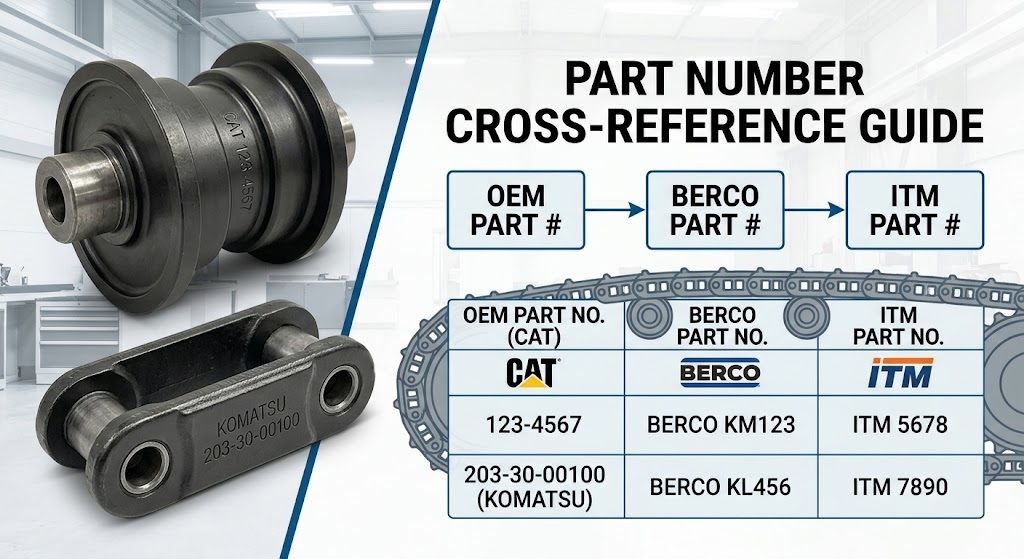
Aftermarket specialists such as Berco and ITM build parts for a wide range of machines and use their own internal numbering systems. These numbers are not translations of the OEM number. They are independent catalog entries that describe the same physical part.
This is the key point for buyers: cross-referencing is not a matter of converting one number format into another. It is a matter of matching the physical specification. Bore and shaft diameters, flange type, link pitch, shoe width, and mounting dimensions are what actually decide whether a part works, and the numbers are only a way of locating that specification in a catalog.
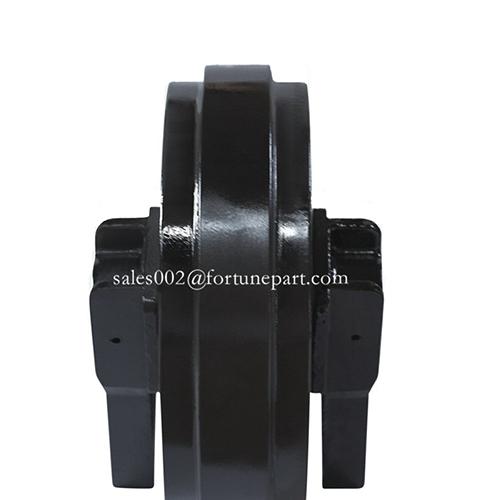
Because these catalogs cover many brands, the same component family appears repeatedly under different machine names. A good example is the undercarriage of European excavators, where a machine may be quoted with an original number and a corresponding aftermarket number that looks nothing like it. Operators comparing a Berco equivalent track roller for Liebherr excavators with the original part are really comparing dimensions, not number formats, and that is the comparison that determines whether the part will fit.
The table below summarizes the typical meaning of each element. Treat it as a general pattern rather than a rule, because every manufacturer applies its own conventions.
| Element | What It Usually Tells You | How to Verify It |
|---|---|---|
| Group prefix | The component family, such as undercarriage, engine, or attachment | Check the parts manual section for the machine |
| Main sequence | The unique item within that family | Search the number in the supplier catalog and read the description |
| Revision suffix | An updated or alternative version of the same part | Ask the supplier which suffix is current and interchangeable |
| Machine model link | The models the part is listed for | Confirm your exact model and serial range, not just the model name |
| Position note | The mounting position, such as single or double flange roller | Compare with the old part or the machine parts diagram |
Suppliers can only confirm a match when they receive the right information. The following list is what a professional cross-reference normally requires.
| Information | Why It Is Needed |
|---|---|
| Machine brand, model, and serial number | Different production ranges may use different undercarriage specifications |
| Original part number, if available | Gives the starting point for the catalog search |
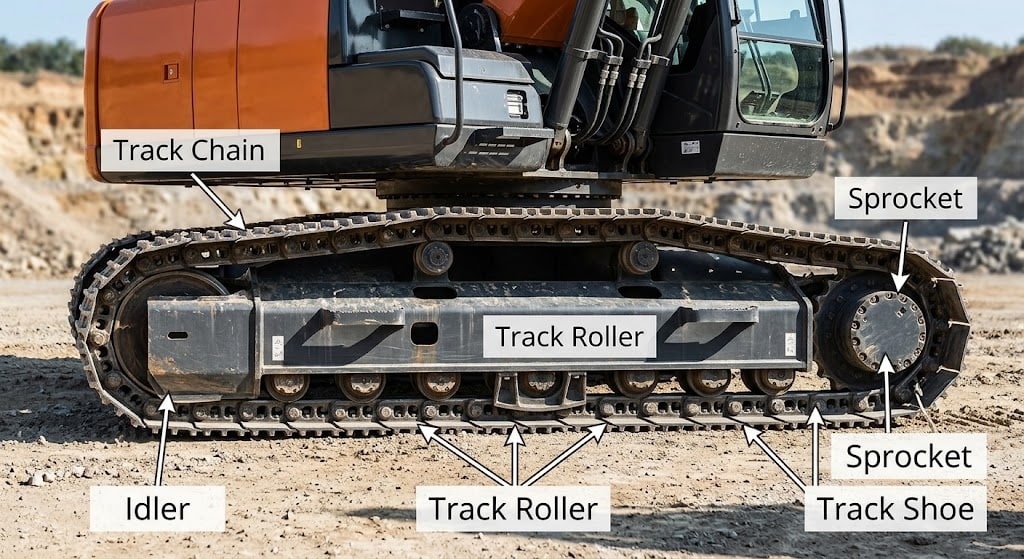
| Component type and position | Distinguishes track roller, carrier roller, idler, sprocket, and track shoe, and their positions |
| Key dimensions of the old part | Confirms the match when numbers cannot be read or do not exist |
| Photos of the old part with a measuring reference | Helps the supplier spot flange type, mounting style, and wear features |
| Quantity and application details | Supports stock check, packaging, and shipping planning |
Before ordering, spend a few minutes locating the original number. It saves far more time than it takes.
| Location | What You May Find |
|---|---|
| Machine parts manual | The complete undercarriage parts list with position diagrams |
| Stamped or cast on the part | The original number, sometimes partially worn or covered by paint |
| Machine data plate | Model and serial number needed to confirm the correct range |
| Service records or previous invoices | The number previously purchased, useful when the part is already replaced |
| Supplier catalog by machine model | The aftermarket number that corresponds to the original specification |
Most ordering errors follow a small number of patterns:
Each of these mistakes is avoidable with a short checklist. The most useful habit is to record the machine details and dimensions once, keep them in the service file, and reuse them for every future undercarriage order.
Consider two common situations. In the first, an operator needs track rollers for a European excavator and has only an original number that the local dealer no longer stocks. The correct approach is to confirm the machine model and serial range, measure the roller diameter, shaft diameter, and flange type, and then ask the supplier for the catalog entry that matches those dimensions.
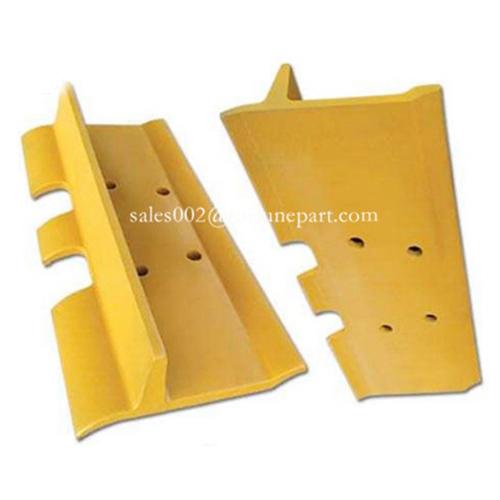
In the second situation, an owner runs several Caterpillar dozers of different sizes and needs to keep track shoes in stock. Because the machines differ in link pitch and shoe width, the parts are not interchangeable between models, and each machine needs its own confirmed entry. Working from a catalog organized by machine and component, such as the reference for Caterpillar track shoe pad part numbers D6H D7G D8T makes it practical to confirm the right number for each machine and avoid mixing stock that looks similar but does not fit.
Yes, and it is the normal practice. The supplier uses the OEM number as a starting point to locate the equivalent aftermarket specification in their catalog.
Measure the part and confirm the machine model and serial number. Dimensional data plus photos is usually enough for a supplier to identify the correct item.
They are separate brands with separate catalogs. A part from either brand may suit the same machine, but the match must be confirmed by specification, not assumed from the brand.
Not necessarily. A superseded number often shows an updated version of the same part. Ask the supplier which number is current and interchangeable.
Different manufacturers list the same physical specification under their own catalog numbers, and one part may fit several machine models. Confirming the model list is part of a proper cross-reference.
Reading undercarriage part numbers is a skill built on two habits: understanding that OEM, Berco, and ITM numbers are separate catalog systems, and confirming the physical specification rather than trusting a similar-looking number. Record the machine model, serial number, and key dimensions once, keep them with the service records, and use them for every undercarriage order. Done this way, cross-referencing becomes a quick routine instead of a source of wrong parts and extra downtime.
Contact fortunepart.com with your machine model, serial number, and the original part number or dimensions, and we will help you confirm the correct undercarriage part before you order.
Mots clés :
catégories
récent des postes
Mots clés
Xiamen Fortune Industrial Co., Ltd.
Room 402,No.7,Kangleli,Huli District, Xiamen, Fujian, China
Tel : 0086 13559245184
Fax : 0086-592-7072790
Whatsapp/Wechat : +8613559245184
Contact Person: James Xie
Email: sales@fortunepart.com
Microsoft Teams: part-sales
numériser pour wechat: